
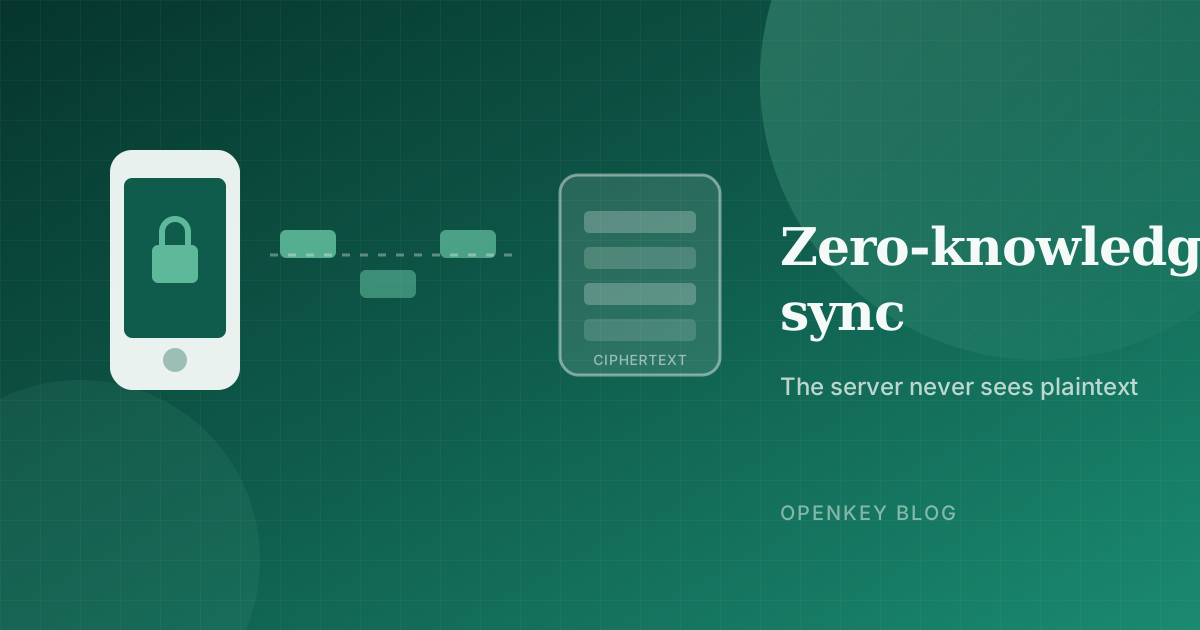
Zero-knowledge sync explained
Sync is useful. Trusting a remote machine with your passwords is not. OpenKey separates those ideas: you can sync across phones, desktops, and the browser extension while the server only ever stores ciphertext.
What “zero-knowledge” means here
- Your master password stays on the device. Clients derive a master key with Argon2id from email + master password and a salt.
- Login sends an
auth_hash— enough to prove you know the password, not enough to recover it. - A vault key encrypts collection names and entry payloads with AES-256-GCM. The server stores only a wrapped (encrypted) vault key, never the plaintext key.
- Attachments, organization names, and share payloads leave the device already encrypted. The sync API persists opaque blobs; it cannot decrypt them even if the database is copied.
What the server is for
The optional OpenKey server is a sync and auth surface:
- Account registration and login (via
auth_hash) - Push / pull of encrypted vault payloads (last-write-wins by per-item
revision) - Organizations and shares — still ciphertext at rest
- Short-lived access JWTs and hashed, rotated refresh tokens
It is not a place that reconstructs your vault. If you never configure a server URL, the app still works as a local encrypted vault. There is also no master-password recovery: if you lose it, ciphertext is unrecoverable — keep an offline backup.
Nearby on the LAN
Want multi-device sync without standing up PostgreSQL? Nearby (Pro) pairs devices on local Wi‑Fi, links a shared vault key, and syncs ciphertext between them with the same LWW rule. Treat pairing and vault link like full vault trust; it is not a substitute for encrypted backups.
Why this model matters
Cloud password managers ask you to trust their infrastructure and their operators. OpenKey asks you to trust your host (or a VPS you control) with storage and uptime only — not with secrets. A stolen database is not a stolen vault.
Dig deeper
- Security — key derivation, threat model, and operational checklist
- Server setup — install Docker sync and link clients
- Using the app — Nearby, backups, and everyday vault use
- Quick start — run the stack locally