
Browser extension
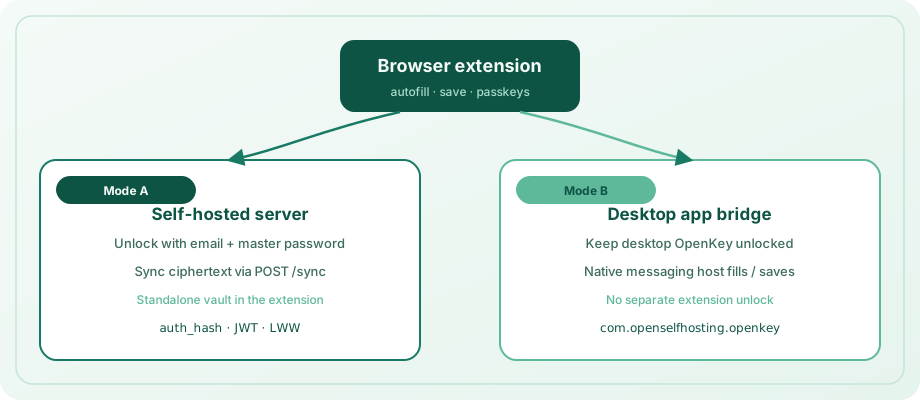
MV3 extension for Chrome, Edge, Brave, Vivaldi, LibreWolf, and Firefox. It can unlock against your self-hosted server (standalone) or fill through the unlocked desktop app (native messaging).
Host name: com.openselfhosting.openkey
What it does
- Standalone vault — unlock with email + master password; sync ciphertext from your server
- Native bridge — when the desktop OpenKey app is unlocked, fill and save via native messaging
- Autofill — overlays, context menu, and keyboard shortcut for logins and payment cards
- Save / update — capture new logins from the page into the vault
- Passkeys — intercept WebAuthn
create/get; store ES256 credentials (extension unlocked) - Cards, crypto & secrets — browse, create, edit, fill/copy; card banks and crypto folders; brands match the app (Visa through Mir / Elo / RuPay / UnionPay / Hipercard). Native-bridge mode writes through the unlocked desktop app.
- Attachments — list and download decrypted attachments for a login (standalone)
- Shares & orgs — list/accept/revoke shares and org invites (standalone)
Keyboard shortcut
| Action | Windows / Linux | macOS |
|---|---|---|
| Fill login with OpenKey | Ctrl+Shift+L | ⌘⇧L |
Browsers may require you to confirm or remap the command under extension keyboard shortcuts if another extension already claimed it.
Install (unpacked)
Store listings may not be published yet. Build and load locally:
cd openkey_extension
npm install
npm run build- Chrome / Edge / Brave:
chrome://extensions→ Developer mode → Load unpacked → selectdist/ - Firefox:
about:debugging→ This Firefox → Load Temporary Add-on → pickdist/manifest.json
Copy the extension ID from the popup or Options page — you need it to connect the desktop bridge on Chromium browsers.
Permissions
The extension uses <all_urls> host / content-script matches so autofill, login capture, and passkey interception work on sites you visit (a fixed allowlist cannot cover the open web). Ciphertext sync and unlock stay on your device or your self-hosted server; OpenKey does not exfiltrate page HTML to a vendor cloud. Prefer Use desktop app when you want fill without unlocking a separate extension vault.
Unlock modes
Self-hosted server
- Set Self-hosted server URL in the popup or Options.
- Create account (register) or Unlock (prelogin + login with the same email and master password as the app).
- Ciphertext syncs through
POST /sync. Master password never leaves the client.
Desktop app bridge
- Unlock the OpenKey desktop app.
- Enable Autofill / connect the extension (platform steps below).
- In the extension choose Use desktop app.
Fill and save go through the unlocked app — no separate extension vault unlock required for those flows.
Optional: Settings → Browser extension → Copy offline vault link in the app for air-gapped bootstrap.
Connect native messaging
Windows
Opening Settings → Security (Autofill toggle) registers openkey_native_host.exe under:
HKCU\Software\...\NativeMessagingHosts\com.openselfhosting.openkey
For Chromium, write the unpacked extension ID to:
%LOCALAPPDATA%\OpenKey\chrome_extension_id.txt
then open Autofill again so the host manifest regenerates. Firefox uses [email protected] automatically.
Keep the vault unlocked (loopback TCP).
macOS
On unlock, OpenKey installs openkey_native_host.py and writes manifests under Chrome / Chromium / Edge / Brave / Vivaldi / Firefox / LibreWolf NativeMessagingHosts folders.
- Load the unpacked extension and copy its ID.
- App: Settings → Browser extension → paste ID → Connect extension.
- Keep the vault unlocked → extension: Use desktop app.
Requires Python 3 on PATH.
Linux
Settings → Security (Autofill toggle) writes host manifests under ~/.config/google-chrome/ (and Chrome Beta), Chromium, Edge, Brave, Vivaldi, ~/.mozilla/native-messaging-hosts/, and ~/.librewolf/native-messaging-hosts/.
Chromium extension ID file:
~/.local/share/OpenKey/chrome_extension_id.txt
then tap Autofill again. Firefox uses [email protected].
Bridge socket: $XDG_RUNTIME_DIR/openkey-native.sock (keep vault unlocked).
Save captured logins
After a login submit (or login button / Enter), an in-page banner offers Save or Update:
- Native bridge —
createEntry/updateEntryon the unlocked desktop app - Standalone — encrypt locally and push ciphertext via sync
Same host + username + password is ignored; a changed password prompts update.
Passkeys
With the extension unlocked, OpenKey can handle WebAuthn on sites. An in-page dialog confirms; choose Use browser to fall back to the platform authenticator.
Smoke test after unlock: webauthn.io or npx tsx src/passkey/smoke.test.ts in openkey_extension.
Related
- Download & install
- Using the app — Autofill and Browser extension settings
- Server setup
- Security — extension trust boundary